
Lifelong Learning: Journey to Decolonize Deepening the Experience - History, Athletics, and Stories!

With Summer in full swing, some may find themselves drawn to spend time outdoors. Maybe for others it’s a good time to cozy up with a good book. Or in my case, I find Summer a good time for both. Lately, I have been inspired to learn more about the history of sports - the good, the bad, the beautiful, and the ugly. In that search, I found stories. Stories of athletes whose names are not spoken of, remembered, or honored who represented the United States of America (USA) in the Olympic Games. These athletes contributed so much, yet are seemingly largely lost, relegated to the annals of athletic history.
Let’s Go Back in Time
Our journey begins back in the years leading up to the 1936 Berlin Olympics. The USA was deciding whether to boycott the Olympics due to Hitler’s policies in Germany. There were arguments on both sides as to whether the USA should participate. The NAACP wrote and spoke out against attending, while many of the athletes were proponents of going. Imagine working day in and day out, making sacrifices, and training hard to go to the Olympics, only to have that moment taken from you. There was no easy answer for some. When it came down to the final vote of the USA Olympic Committee, only a few votes separated the members who voted to go and those who voted to boycott. There was a voice on the committee that strongly favored attending and had been instrumental in persuading others. The USA would attend the 1936 Berlin Olympics.

Meet the Olympic Athletes
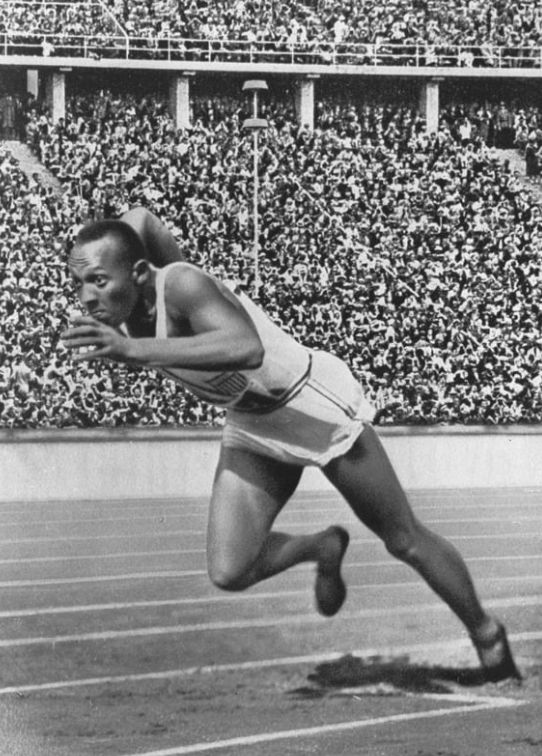
18 Black athletes qualified to participate in the 1936 Olympics and sailed to Germany.
Track and Field
Jesse Owens
Archie Williams
James LuValle
Ralph Metcalfe
Cornelius Jackson
Matthew “Mack” Robinson
Dave Albritton
Fritz Pollard, Jr.
John Woodruff
John Brooks
Boxing
Jack Wilson
Art Oliver
Howell King
James Clark
Willis Johnson
Weightlifting
John Terry
Women’s Track and Field
Tidye Pickett
Louise Stokes
Stepping Back Four More Years to 1932
Tidye Pickett
Louise Stokes
These two amazing athletes qualified for the 1932 USA Olympic team. Their inclusion in the track and field at the time was controversial because of their race and gender. It was not until 1928 that women were allowed to compete in track and field at the Olympics. Before then, women were only allowed to participate in sports such as golf, tennis, or archery. The “less-strenuous” events.
At the Olympic trials, Pickett and Stokes qualified for the team as part of the 4 x 100 relay pool. Stokes’ finishing time for the 100-meter had her in fourth, and Pickett’s time had her in sixth place, making her an alternate. The runners for the race itself would not be selected until the Olympic Games.
Their journey to the 1932 games in California was not a pleasant experience. Mildred “Babe” Didrikson, a well-known and accomplished athlete, dumped a pitcher of ice water on them when they were sleeping. Additionally, at a team dinner in Denver, CO, hosted at the Brown Palace, they were not welcome in the main dining space. Their Olympic experience ended when they were both replaced in the relay by two white athletes, who had run slower times than either of them at trials. That relay team would go on to win gold. Pickett and Stokes were robbed of the spots that they had earned.
The 1936 Olympics
Tidye Pickett
Louise Stokes
To go to the 1936 Olympics, it took community. Stokes’ hometown helped make her Olympic trip possible by raising $680 to pay for her trip. While Stokes did not do well at the Olympic trials, she was still invited to join the pool of athletes eligible to run the 100 x 4 relay. She would watch as her teammate, Pickett, was injured running her race and vowing to win gold for her. Heartbreakingly, she would never get the chance to run.
Pickett set an unofficial world record while running the first leg of the Chicago Park District 100 x 4 relay, and she finished second in the 80-meter hurdles. This finish allowed her to qualify for the 1936 Olympics automatically. At the age of 21, Pickett became the first African-American woman to compete in the Olympic Games. She made it to the semi-finals in the 80-meter hurdles, where she hit a hurdle and broke her foot.
There are 16 other athletes listed above who each have a story about their Olympic experiences.
There are 18 athletes listed above who made history and, on a world stage, contributed to the Civil Rights Movement through athletics.
Final Thoughts
It’s time to dive deep. Dive into the stories and the history that are not shared in the mainstream to learn more. I encourage you to learn more about the athletes discussed in this post using the references below. Or if you have an interest in another sport or discipline, take some time to dive deep and learn the names and stories of those who are not given the time and attention that they deserve. A colonized education directs us and educates in only a Eurocentric direction, and thus, we are missing so much. Part of decolonizing our education is taking the initiative to explore areas that we may not have thought of. I, admittedly, had thought about doing a deep dive into sports until recently. I am so glad that I did because of the significance of what these athletes contributed. Challenge yourself to think “outside of the Eurocentric box” and explore areas and stories that we may not have given attention to before because we were told or led to believe that these areas are not important. Take that leap of faith!
What’s Next?
Take that deep dive into the stories and histories that have not been or are not often discussed.
Take time to reflect on what you learn. How did the lessons learned and stories impact you? How can you use this new knowledge in service to decolonize your work with minoritized youth?
If you are inspired, keep going! Keep taking deep dives and learning more and more. Commit yourself to take the time.
Consider inspiring others to take deep dives! Passion and inspiration can be catching!
Practical Tips and Suggestions
Set intentions for yourself to keep you focused. For example, consider setting an intention around boundaries to ensure that you take the time to do your deep dives.
Share and use what you learn. We can spend a lot of time learning, which is terrific! The next step is to be brave and incorporate your learning into your work.
Remember the value of story! Stories are all around us. If you are not a fan of doing deep dives in books or on the Internet, remember there are people around us with stories to share. Remember the elders in your community. Their stories are gems!
References
Draper, D. R., Underwood, B., & Thrasher, T. (2020). Olympic pride. American prejudice. Atria Books
Goldblatt, D. (2016). The games: A global history of the Olympics. Norton.
Olympic Pride, American Prejudice
Olympic Pride, American Prejudice - Full Film
Theodore “Ted” Corbitt


Comments